
The Charlevoix County Owner-of-Record Card
Equalization maintains ownership records for 15 townships. It also tracks legal descriptions, parcel IDs, and 911 addresses, and its PivotPoint Property Information Portal serves as the county's assessment-roll lead for any property search.
| Owner of Record | Person, trust, estate, or entity shown at the roll's present stage |
|---|---|
| Vesting / Tenancy | Wording to verify on the recorded instrument |
| Mailing Address | Destination for assessment and tax correspondence |
| Situs Address | Physical parcel location, separate from owner mail |
| Deed Reference | Book/page or instrument key when supplied |
| Ownership Since | Transfer lead that requires deed confirmation |
The owner of record is not always the occupant. Mailing data shows where notices go, not where a person lives, so treat those two fields differently in Charlevoix County property records.
Confirm the Current Charlevoix County Owner
Start with the roll for the parcel and name. Then confirm the transfer through the Register of Deeds index, which holds the dated deed; searching it requires brief registration.
- Copy the owner name and parcel number from PivotPoint
- Search the Register of Deeds for the newest matching grantee
- Check Michigan entity records when the owner is an LLC
- Keep the mailing address separate from the parcel situs
- Owner of record
- The name carried on the present assessment roll.
- Vesting
- The deed wording that states how title is held.
- Registered agent
- The formal entity contact, not necessarily the owner.
Charlevoix County Publishes No Roll-Lag Promise
The portal's date-last-processed field sits blank. No closing-to-roll interval is published, so a Charlevoix County deed can record before Equalization posts the transfer to the tax roll.
Recent sale. The newest recorded deed is the stronger dated source while the roll still identifies the parcel and prior processing state.
Read a Charlevoix County Owner Name Exactly
PivotPoint labels its field “Owner Name (Last First),” and Quick Search matches only entries that start with typed text. Copy names exactly. Preserve initials, trustee language, and punctuation. Recent Charlevoix County sales include estate, trust, and LLC transfers, so the familiar name may not match the roll.
The Newest Charlevoix County Deed Can Beat the Roll
Recorder Basic search takes last name first. Use no punctuation. The Advanced option adds wildcard searches along with include and exclude operators. Online images run $1.05 per page plus $0.30 per cart. For a certified copy, call 231-547-7204.
The recorder publishes no stated start year for the online index.
Charlevoix County Owner Mail Can Point Elsewhere
One portal sample pairs county property with a Petoskey post-office box. That box is correspondence routing. It does not place the parcel. Michigan's Address Confidentiality Program can give qualifying survivors a substitute address with mail forwarding. The situs field shows where the parcel physically sits. The mailing field shows where the custodian sends notices.
Keep both in your notes. But never use the correspondence city to change the parcel's municipality or tax district.
Verify a Current Charlevoix County LLC Owner
The Michigan MiBusiness Registry adds filings, annual statements, certificates, and historical-card context. A registered agent is an entity contact. The agent is not automatically the landowner. Trust and estate styling must likewise be matched to the deed. The entity search supports an identity check. It cannot replace the grantee line and legal description in the newest county deed, and a manager or member should never be recast as parcel owner without a title instrument that says so.
Inspect the Current Charlevoix County Portal Entry
The Charlevoix County Property Information Portal offers Quick Search plus links into property, sales, map, and tax information. It anchors any present owner-of-record check.
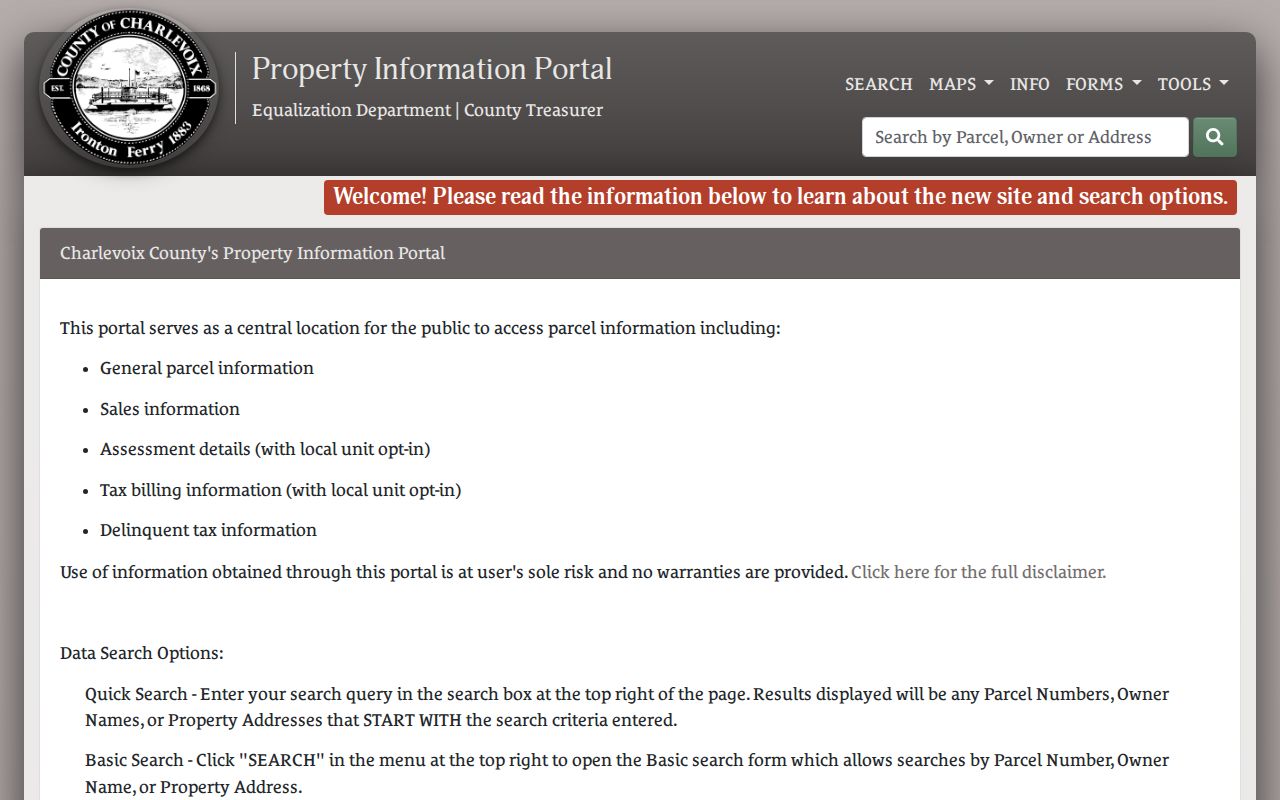
Quick Search uses starts-with matching for owner names, parcel numbers, and property addresses. A failed query is not proof of absence. If nothing comes back, try the Advanced Search fields or contact Equalization directly. The parcel may still exist in county property records. Its current owner record may too.
Test a Charlevoix County Current Owner Against Recent Sales
The weekly PivotPoint sales table lists parcel, date, prior owner, new owner, address, acreage, and amount columns. It flags recent transfers worth a recorder check.
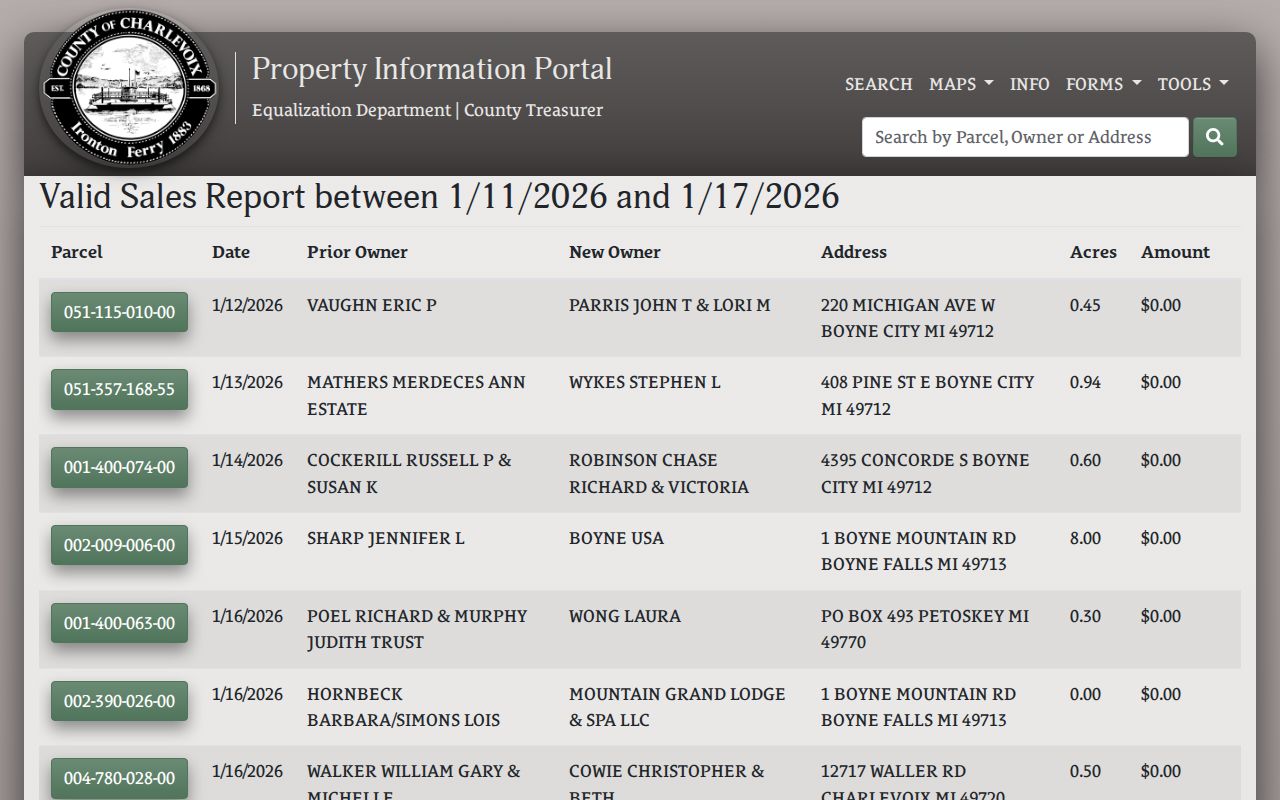
Some rows involve estates, trusts, LLCs, out-of-county mailing addresses, or zero-dollar amounts. Price is not ownership. Neither is a mailing city. The current-owner answer belongs to the deed, not to inferred details from sales property records.
Ask Charlevoix County Equalization About a Pending Change
When the newest deed and the roll disagree, call Equalization at 231-547-7230 or email equalization@charlevoixcounty.org. Give the full parcel ID. Include the deed recording date plus the document number or book and page. Include the exact old and new names. Ask whether the transfer has reached the ownership-maintenance workflow. Ask when the public roll was last processed.
Equalization handles parcel IDs, legal descriptions, 911 addresses, assessment data, and ownership records. The Register of Deeds records the deed separately. Keep that split clear. That way you never ask the assessor to certify title or the recorder to explain tax-roll timing.
Local Assessors Add Context to a Charlevoix County Owner Record
A countywide owner lead can still point to a city or township assessor for the latest local context. The City of Charlevoix assessor page posts its own parcel-search route, assessment notices, and Board of Review information. Boyne City and East Jordan run BS&A-connected municipal interfaces. None of these local pages replaces the Register of Deeds as title-instrument custodian.
First confirm the situs. It may sit inside Boyne City, Charlevoix, East Jordan, or one of 15 townships. A postal place name can cross the government boundary that fixes the assessor and permit keeper. Then ask that local unit whether a recent ownership change appears in its working assessment file. Use the county recorder date to document the deed.
This matters most near the assessment-notice cycle. Charlevoix City mails change notices at the end of February. Its March Board of Review meets the second week. That schedule covers city parcels only. It is no countywide posting promise for property records.
Route a Charlevoix County Owner Difference to the Right Custodian
Sort every ownership question by the office that owns it. A misspelled owner name or a pending assessment-roll change goes to Equalization and the local assessing unit. The Register of Deeds handles indexing, recording dates, images, and certified copies of the deed. Delinquent taxes belong to the County Treasurer. A probate order or fiduciary appointment sits with the 7th Probate District clerk. The deed conveying the parcel stays in the recorder trail.
An owner name reading "Estate" calls for three searches: the decedent, the personal representative, and any later grantee. Probate files explain who holds authority, but MiCOURT shows no wills and excludes protected categories. For older estates, the Archives of Michigan guide covers probate calendars. It spans 1882 through 1968 and case files from 1882 through 1970. Those records can bridge a name change without ever replacing the recorded deed.
Trust-owned parcels need both the trust title and the trustee name, since instruments style them differently. When the party role is unclear, use the recorder's Both Names choice. Basic search wants a last name first, with no punctuation. Advanced search allows wildcards plus required and excluded terms. Save the exact query and retrieval date so any current-owner check can be reproduced later.
If online searching leaves a mismatch unresolved, send a focused written request. Ask for an older assessment roll, an ownership-change record, or processing details. A Michigan FOIA request should identify the parcel, the record series, and the date range. It should also ask for electronic copies when practical. The statute allows five business days for a response. It is extendable by written notice for up to ten more. A FOIA reply never substitutes for a certified deed.
Reaching a Charlevoix County Property Owner
A public mailing address can support a legitimate property contact. It still does not identify an occupant. Michigan also offers qualifying survivors a substitute address through its Address Confidentiality Program.
Lawful use. Use current-owner records for lawful property research. Never use them to stalk, harass, threaten, or harm anyone.