
Charlevoix County Deed Records Explained
A deed becomes a Charlevoix County record once the Register of Deeds accepts it. The office then indexes the instrument. It names the parties and describes the land or interest changing hands. An index entry points the way. The document image tells the real story, with its legal description, reservations, signatures, and acknowledgments. Deed type matters too, since different forms carry different interests and promises.
| Deed Type | What It Does | Common Use |
|---|---|---|
| Warranty deed | Conveys the stated interest with title covenants | Ordinary arm's-length transfer |
| Quitclaim deed | Conveys whatever interest the grantor has | Family, trust, or title cleanup |
| Fiduciary deed | Conveys through an authorized representative | Estate, trust, or court-related transfer |
| Sheriff or treasurer deed | Records a transfer through a statutory process | Foreclosure or tax proceeding |
| Plat or related instrument | Creates or affects recorded land descriptions | Subdivision and common-element work |
Mortgages, liens, easements, covenants, and releases all get recorded beside deeds without transferring ownership. Each one plays its own role in a parcel's history. The county publishes no complete online list of document types. So run broad or all-type searches first. Narrow the results once something useful surfaces.
Search Charlevoix Deeds by Name
The official EagleWeb recorder portal accepts grantor, grantee, both names, date range, document type, and document number. Basic name search wants last name first, no punctuation. The recorder's own help screens use Franklin Benjamin as the sample format. Advanced mode behaves more like a web query. An asterisk works as a wildcard, a plus sign requires a term, and a minus sign excludes one. Word order drops out entirely.
Try both forms when initials, suffixes, spellings, trusts, estates, or LLC names complicate a search. Both Names helps when a party's role is unclear. Brief registration unlocks document searching, and the portal needs cookies and JavaScript enabled. Search access and image purchase stay separate.
Charlevoix Recorder Search Fields
Begin with a known party, date, or reference. Add a second criterion only if results flood in. The recorder posts no result cap, export rule, complete document-type list, or online start year. A blank result proves none of those things.
| Recorder field | What it locates | Search note |
|---|---|---|
| Grantor | Party transferring an interest | Search seller or prior owner |
| Grantee | Party receiving an interest | Search buyer or later owner |
| Both Names | Either indexed party role | Useful for uncertain roles |
| Start and End Date | A recording period | Same date in both searches one day |
| Document Type | A class of instrument | Multiple types may be selected |
| Document Number | One indexed instrument | Best when copied from another official record |
The alternate Keystone deed portal visibly offers name, date-range, liber/page, document-number, and parcel-number modes.
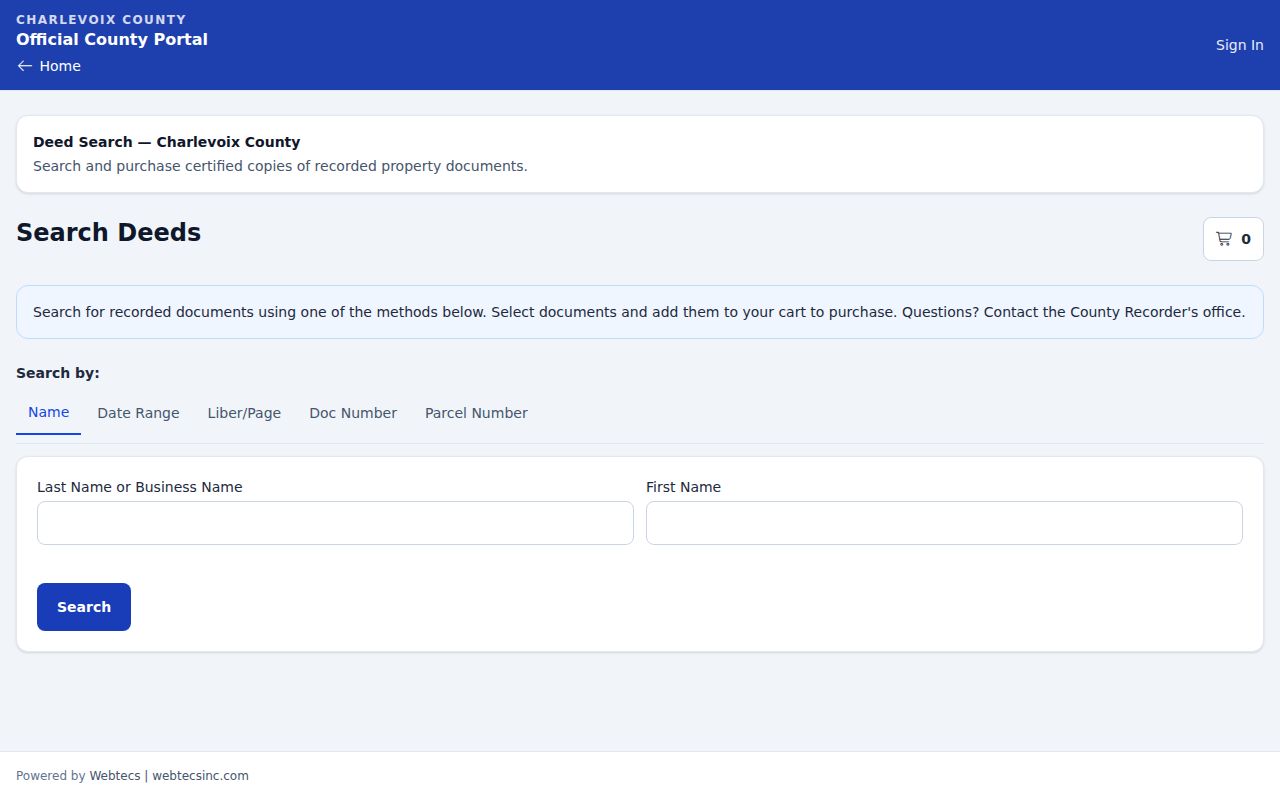
Those routes help when the portal is down or when a reference already in hand beats a party name.
Walk the Charlevoix Grantor-Grantee Chain
The index arranges title documents around people. Start with the newest known owner as grantee. Find the grantor on that acquisition deed. Then hunt for that same grantor's earlier purchase as grantee, and repeat the link down the chain. Record every parcel number, legal description, recording date, and book or instrument reference beside each name, because similarly named people merge easily when details go untracked.
- Find the most recent deed with the current owner shown as grantee.
- Open the image and capture the grantor, legal description, and recording reference.
- Search that grantor as a grantee in an earlier date range.
- Repeat until an index gap, changed parcel, probate event, or older deed-book era appears.
- Grantor
- The indexed party transferring the stated interest.
- Grantee
- The indexed party receiving that interest.
- Chain of title
- The linked sequence of recorded transfers for the same land.
- Liber and page
- A book-and-page reference for a recorded document.
- Instrument number
- A unique recorder reference assigned to a filing.
Trust and Estate Deeds Break Patterns
Charlevoix County sales samples include estates, trusts, LLCs, and transfers among those forms. A fiduciary may sign under a personal name. An estate can linger on the assessment roll. A trust may be indexed under its trustee instead. Run the same terms through both grantor and grantee roles, and weigh sale dates, document types, and legal-description fragments too.
Probate transfers sometimes need several records. MiCOURT offers a docket lead, the 7th Probate District clerk keeps the official file, and the recorder holds the deed finishing the conveyance. Archives of Michigan documents older probate calendars and cases from 1882 through 1970. The probate order establishes authority. The recorded deed proves the transfer.
Older Charlevoix Deed Books
The county publishes no official online-index start year. The solid fallback is the Archives of Michigan Charlevoix guide. It lists Charlevoix deeds from 1852 to 1901 and Manitou deeds from 1854 to 1895. Manitou deeds and abstracts run through 1960. Related mortgage and tax-land series cover other nineteenth-century years.
Charlevoix began as Keskauko County in 1840. It was organized under its current name in 1869. Island property or an early title chain may cross into the Manitou series. Search county-name variants, old owner spellings, township-range-section terms, and historic plat names. The archives asks visitors to contact staff a week or two ahead. Bring the legal description and the desired series.
Online coverage is unverified. Do not assume the modern deed index reaches 1852. The date belongs to the archival series, not the web portal.
Liens and Easements Sit Beside Deeds
The Register of Deeds also holds recorded mortgages, assignments, discharges, liens, easements, restrictions, covenants, rights-of-way, and plats. These instruments shape how land is financed, used, accessed, or described without changing the owner of record outright. Search both parties across a wide date range. Then inspect the exact document type a result shows.
Court files add context to quiet-title cases, foreclosures, boundary disputes, and lien enforcement. MiCOURT gives an informational docket lead. The local clerk holds the official case record. Search the recorder again afterward for the lis pendens, judgment, deed, release, or easement that carries the court's outcome into the property records.
No Fraud Alert Was Verified
Charlevoix County offers no official property-fraud alert enrollment page. Treat any signup service with suspicion. Do not mistake the general county home page for one. Concerns about an unexpected deed or lien belong first with the Register of Deeds. Then take them to legal counsel or law enforcement as warranted.
Checking the deed index regularly can surface a newly recorded instrument. That habit is not automatic monitoring, and it settles nothing about validity. Save the document number, image, recording date, parties, and parcel description before seeking help.
Charlevoix Deed Images Carry Details
An index row only gets you to the door. Open the image itself. You can find the full legal description, reservations, exceptions, and consideration language. Marital status, execution date, notary acknowledgment, and the recording stamp also appear there. So can references to earlier documents. Copy the details exactly. A name or parcel number alone may not tell a whole-parcel transfer from an easement. It may not reveal a mineral interest, common element, or partial interest either.
Images online are PDFs, and the recorder system sells them by the page. Record the instrument reference before ordering. For a court, estate, closing, or other formal matter, ask the Register of Deeds about a certified copy. Ask whether one is required. Certification authenticates the office copy. It does not make the recorder a title examiner or settle legal meaning.
Charlevoix Deeds Need Parcel Cross-Checks
Names change more often than land does. Carry the parcel number forward from deed to deed. Subdivision, lot and block, acreage, township-range-section, or metes-and-bounds text all help. A parcel split, combination, condominium plan, or boundary adjustment can end a clean one-number trail. When the shape or legal description changes, search both the retired and current APN. Use both the retired number and the current one with Equalization.
The PivotPoint sales table can yield a recent prior owner, new owner, date, address, acres, and amount. Rows include $0 amounts, estates, trusts, LLCs, and mailing addresses outside the county. Treat that list as a route into deed records. Match the parties and the date. Then read the instrument itself. Learn whether the event was a market sale, nominal transfer, fiduciary deed, or internal restructuring.
Office and Archive Channels Stay Essential
The online portal is one channel, not the only one. At the Register of Deeds counter, staff can help locate an instrument and provide plain or certified copies. Bring names, an estimated recording period, document type, parcel or legal description, and any book/page or instrument number. The official state directory lists the office at 13513 Division Street, Charlevoix, open weekdays from 8:00 to 4:30. Another county directory holds older, conflicting details. Call 231-547-7204 before visiting.
If the online index ends or a name search breaks, contact Archives of Michigan with the county series and land description. Archive staff recommend reaching out ahead of time. The 1901 plat book at Charlevoix Public Library, along with local newspapers, can pin down an old subdivision or spelling. Probate and court clerks may explain authority or litigation. Each source supplies one link. The recorded deed remains the transfer evidence.
Order a Charlevoix County Deed
EagleWeb prices online PDF images at $1.05 per page, plus $0.30 for each cart transaction. An online image works for research. It is not automatically a certified copy. Michigan law sets baseline register fees, including $1 per copy page and $5 to certify a recorded document. Grantor-grantee staff searches run $0.50 per year with a $5 minimum. The county's current counter schedule is not published online. Ask for the total before ordering.
The Register of Deeds sits at 13513 Division Street, Charlevoix, MI 49720, phone 231-547-7204, weekdays 8:00 to 4:30. An older county directory conflicts on the address and officer name. Confirm current visit details first. Provide the instrument number or liber/page, document type, party names, recording date, and whether you want certification. Ask whether mail service and payment instructions differ from an office request.
Recorded, not guaranteed. Charlevoix County deed records show what was accepted and indexed. They do not resolve every unrecorded interest or provide a title opinion.