
Fields Inside Charlevoix County Property Tax Records
Value facts and collection facts sit in different offices. Equalization and the local assessor explain how a Charlevoix County parcel was valued. The Treasurer handles the other half. County tax receivables and tax searches sit there. The Treasurer also tracks delinquent property taxes, and PivotPoint can pull several of these facts together, though its own notice says assessment and tax detail depends on which local units participate.
| Field | What It Shows | Where |
|---|---|---|
| Assessed value and SEV | Approximately half of true cash value under Michigan equalization rules | Local assessor and Equalization |
| Taxable value | The Proposal A constrained base used for tax calculation | Assessment record |
| PRE status | Whether the principal residence school-operating exemption is applied | Assessment record |
| Current local tax data | Bill details supplied by a participating local unit | PivotPoint or local treasurer |
| Delinquent status | County-held tax receivable after the local collection period | Charlevoix County Treasurer |
Assessed value, taxable value, and sale price are not the same thing. SEV estimates true cash value. Taxable value may stay below SEV. A transfer generally uncaps it in the following tax year, while the price a buyer actually paid belongs to the sales and deed records rather than the tax bill.
Equalization and Treasurer Split the Charlevoix County Tax Trail
Start with the Charlevoix County Property Information Portal, the practical entry point for parcel, assessment, sales, and optional tax information. Equalization assigns parcel IDs and 911 addresses. It also keeps legal descriptions and ownership records. The department pushes for uniform assessment at 50 percent of true cash value across 15 townships. Visit 13513 Division Street on weekdays, 8:00 a.m. to 5:00 p.m. Call 231-547-7230.
The Treasurer sits at the same address and handles delinquent property taxes and tax searches. Hours run 8:00 a.m. to 4:30 p.m. weekdays. The phone is 231-547-7202. If the portal lacks a local tax panel, ask the local collecting unit for a current bill and the County Treasurer about delinquency.
Note: Confirm office hours before traveling because county directory records contain some older location details.
Search Charlevoix County Assessments in PivotPoint
The PivotPoint advanced search goes well beyond a broad address query. Narrow a large result set before opening any parcel. Quick Search works differently. It matches parcel numbers, owner names, or property addresses that begin with the text you type.
| Search group | Available fields | Useful tax purpose |
|---|---|---|
| Owner and parcel | Owner Name, Parcel Number | Find the assessment attached to a known taxpayer or APN |
| Address | House Number, Direction, Street Name, Street Type | Separate similar street addresses |
| Location | Tax District, Township, School District | Identify the units behind a levy |
| Property | Class, acreage, exemption, PRE | Review classification and exemption filters |
| Sales | Date, price, buyer, seller, valid-sale status | Compare a value record with transfer evidence |
A search result is a lead, not a certified tax search. Save the parcel number and taxing unit so the right office can reproduce the record.
Look Up a Charlevoix County Tax Bill Step by Step
A complete search covers both halves. Check the assessment base and the collection record. Keep the exact parcel number handy during any Charlevoix County property tax search, especially when the mailing address differs from the situs address.
- Search PivotPoint by exact parcel number or a split street address.
- Record assessed value, SEV, taxable value, PRE status, and the local tax district.
- Open available tax detail, then check the local treasurer if the panel is blank or incomplete.
- Ask the County Treasurer for delinquent status or a certified tax search when reliance matters.
- Assessed value
- The assessor's value, generally set near 50 percent of true cash value.
- Mill rate or levy
- The rate applied by government and school taxing units.
- Principal Residence Exemption
- A school-operating millage exemption for a qualifying principal residence.
- Tax lien
- A legal claim tied to unpaid property taxes, which needs current custodian confirmation.
PRE Forms Shape Charlevoix County Property Tax
The Michigan Principal Residence Exemption program can exempt up to 18 mills of local school-operating millage. It is not the homestead income-tax credit. Nor does it touch the deed. Form 2368 claims the PRE, and Form 2602 rescinds it once a property stops being the principal residence. June 1 is generally the timely claim date for the summer levy.
A rescission is due within 90 days. Denials arrive on Form 2742 from the local assessor. Form 4075 is the county denial notice. Form 4632 covers audits, and the official PRE forms page carries the current version of each.
Why a Charlevoix County Tax Panel May Be Blank
County records help explain the portal itself. A January 14, 2026 County Board packet documents the county's 2025 agreement for a Pivot Point property-information and parcel-map website. The system described there includes real-estate information, sales history, GIS, and property taxes. A township resolution covers assessing and tax-data sharing. That paper trail explains both the current portal and its local-unit participation notice.
A missing tax panel does not mean the parcel has no bill. It may mean the local unit skipped that category. Pull the APN and tax district from PivotPoint. Then contact the local unit or the County Treasurer.
Portal limit. Treat online tax data as an index. A certified tax search from the custodian is the stronger record for a closing or title question.
Trace Delinquent Charlevoix County Property Taxes
The County Treasurer administers delinquent property taxes. No current public delinquent-list page exists online. County audit material says the delinquent tax revolving fund buys unpaid real-property taxes on March 1 after the levy year. That step is accounting, not a tax sale. Confuse the two and you misread a parcel's status.
Call the Treasurer at 231-547-7202 first. Ask for the parcel's current delinquent status, interest, and the record behind any foreclosure stage. Written requests work too. A focused letter under the Michigan Freedom of Information Act can name a date range, parcel, and record series. Michigan FOIA requires a response within five business days and permits a written extension of up to ten more.
Note: A delinquent balance, foreclosure case, treasurer deed, and later resale are separate events that require separate records.
Charlevoix City's February and March Assessment Cycle
Charlevoix City publishes a precise local calendar. The City of Charlevoix assessor page shows that assessment-change notices go out at the end of February, and the Board of Review meets during the second week of March. That rhythm belongs to the city alone. Boyne City, East Jordan, and the county's 15 townships set their own dates, so a Charlevoix calendar should never be assumed to apply countywide.
For a parcel anywhere else in Charlevoix County, start with the assessing unit named on the record. Request that unit's current Board of Review notice, meeting dates, petition form, and delivery rules. Then gather the evidence: the notice, the parcel card, photographs, comparable sales, and any supporting appraisal. Keep all of it together so the correction request stands on complete documentation.
Review the Charlevoix County Tax Estimator Inputs
The PivotPoint Michigan Tax Estimator shows its Taxable Value, Government Units, School Districts, PRE, and Compute controls. Reading those inputs explains how a projected Charlevoix County tax figure gets assembled.
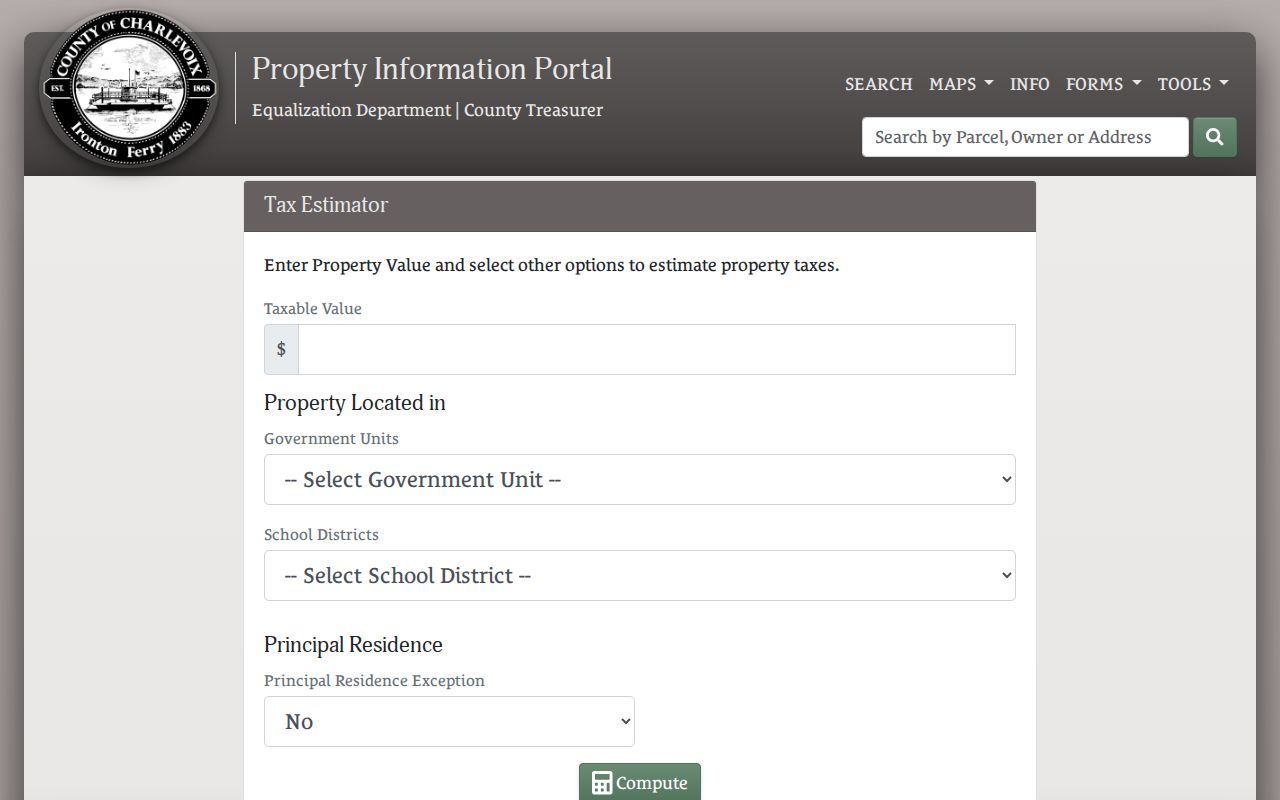
An estimate is not a Treasurer receipt. It is not a certified tax search either. Before relying on a computed figure, confirm the unit, year, PRE status, and actual bill with the custodian of the property records.
Keep a Charlevoix County Tax Search Separate From a Portal Number
A portal screen answers one question: what the shared system displayed at a moment in time. A tax search from the Treasurer is different. It is a custodian's response about the parcel's actual tax status. For a transaction or foreclosure question, provide the complete parcel number and ask exactly which years, local-unit balances, county delinquency, interest, and certification the response covers.
Never treat a deed amount as a tax balance. A tax estimate is not proof of payment either. Each figure lives in a different record series with its own effective date. Save the source, retrieval date, and parcel number so you can compare later, since local units in Charlevoix County post new data on their own schedules.
Contest a Charlevoix County Property Tax Assessment
An assessment challenge starts with the local Board of Review, not the Register of Deeds. Put the notice beside the parcel's physical facts. Check the classification, land and improvement data, and credible comparable sales. Ask the local assessor which petition form applies and how it must be delivered. A PRE denial follows a separate 35-day route under Michigan rules. Local or county denials go to the Michigan Tax Tribunal. Treasury denials follow Treasury procedures.
State guidance allows denial of the current PRE plus the prior three years. A tribunal filing fee may apply. Corrected tax can accrue interest while an appeal is pending. Form 5101 covers certain qualified errors, but it never replaces a timely appeal.
Appeal window. Use the notice and local Board of Review calendar for an assessment appeal. A PRE denial has a documented 35-day appeal period.