
Start a Charlevoix County Property Search
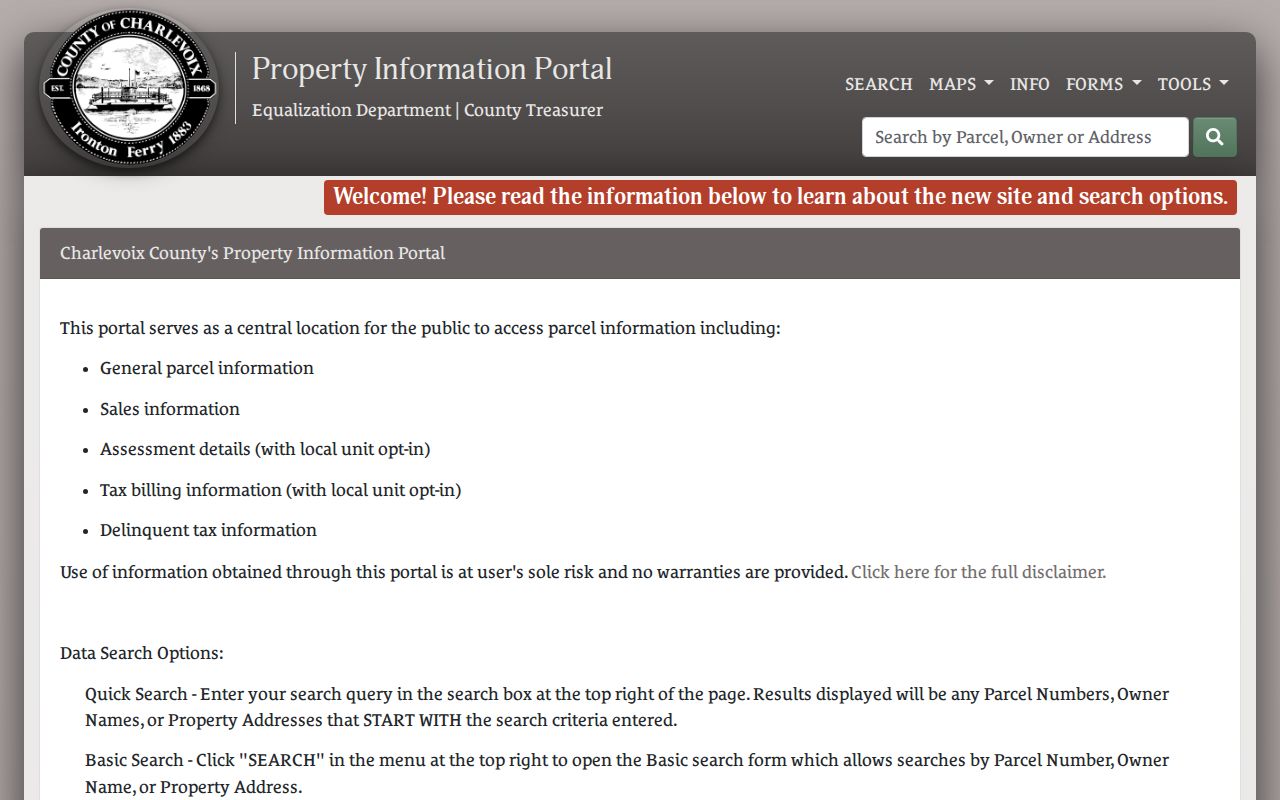
The Property Information Portal is the broadest first stop. Quick Search matches parcel numbers, owner names, and addresses that begin with the typed text. Basic and Advanced Search take separate routes. Use them for an exact parcel, an owner entered last-name-first, or an address split into number, direction, street name, and type. Save the parcel number from a good match. It stays stable when names or mailing addresses differ.
One portal hit is only a lead. Equalization maintains assessment and ownership records. The Register of Deeds holds the instruments that transfer or burden title. The Treasurer handles county tax receivables and delinquent taxes. GIS adds visual parcel context, never a legal survey.
- Enter the address, owner, or exact parcel number in PivotPoint.
- Save the parcel ID, tax district, legal description, and displayed owner.
- Cross-check a transfer in the recorder index by grantee, grantor, or document number.
- Review assessment and tax fields, noting that local-unit participation controls what appears.
- Use the map for orientation, then obtain a deed, plat, survey, or certified copy when proof matters.
For field-by-field help, turn to the Charlevoix County property search. Note: A missing portal panel may mean a local unit has not supplied data, not that the parcel or tax record is absent.
Who Keeps Charlevoix County Records
Three offices at 13513 Division Street divide the main Charlevoix County property records work. The Register of Deeds records deeds and other title instruments. Equalization assigns parcel IDs and 911 addresses across 15 townships. It keeps legal descriptions and ownership data. It also supports uniform assessment at 50 percent of true cash value. The Treasurer manages county tax funds and delinquent property taxes. The office handles tax searches, deeds, plats, and instruments of title. Office directories conflict on the recorder's older address and officer name. Confirm current details before visiting.
Charlevoix County Register of Deeds
13513 Division Street
Charlevoix, MI 49720
231-547-7204
Charlevoix County Equalization
13513 Division Street
Charlevoix, MI 49720
231-547-7230
Charlevoix County Treasurer
13513 Division Street
Charlevoix, MI 49720
231-547-7202
PivotPoint Opens Three Search Paths
Quick Search only helps on a partial match. The typed text must begin the stored parcel number, owner name, or address. Advanced Search is more exact. It combines owner, parcel, address, township, tax district, school district, property class, acreage, exemption, PRE, sale, and building filters. The county publishes no fixed result limit, and the portal leaves its data-processed date blank.
| Portal field | Best use | Format note |
|---|---|---|
| Owner Name | Find parcels held by a person or entity | Last name first |
| Parcel Number | Open one exact county key | Keep zeros and punctuation |
| House, Direction, Street, Type | Resolve a situs address | Direction and type may be abbreviated |
| Township or Tax District | Separate similar addresses | Useful at city and township edges |
| Sale and Building Filters | Study transfers or improvements | Confirm each result in its source record |
The live Basic and Advanced Search shows these controls, and a short failed query is worth reformatting before assuming no record exists.
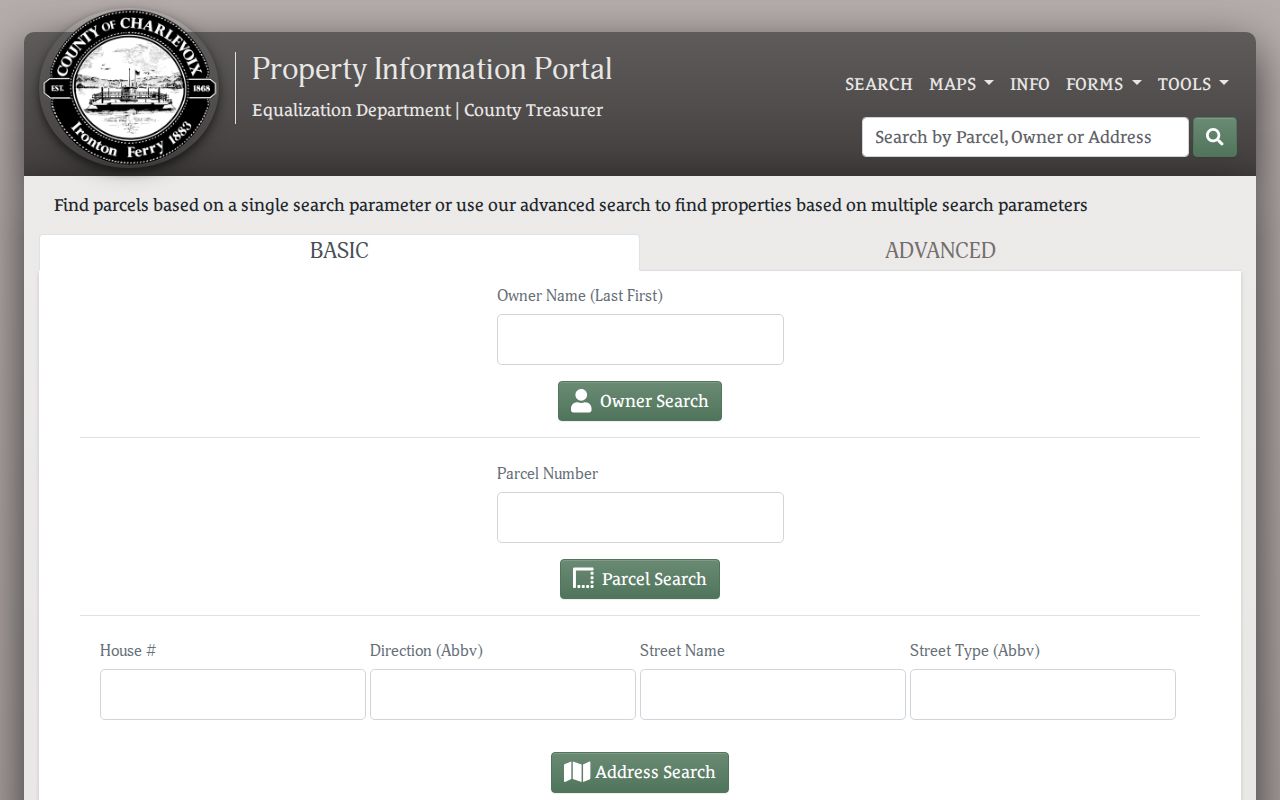
Address, parcel, and owner modes each reach the same parcel record along separate paths.
Recorder Records Add Title Evidence
The Charlevoix County recorder's EagleWeb interface searches by grantor, grantee, both names, date range, document type, or document number. Basic name search expects last name first with no punctuation. Advanced mode supports a wildcard plus include and exclude operators. A brief account is required to search. Buying a PDF image is a separate step. An alternate Keystone deed portal adds name, date, liber/page, document-number, and parcel-number routes on its official page.
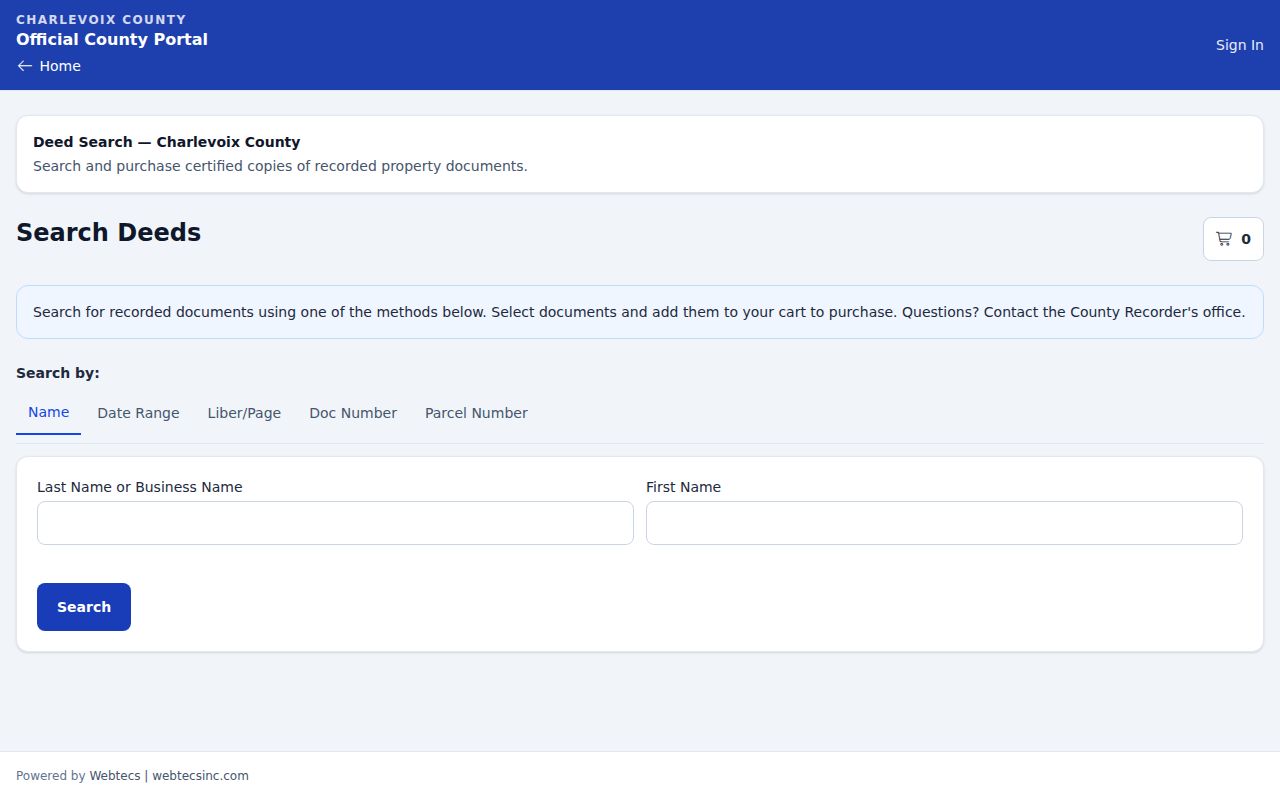
Take the instrument number, date, and parties from a hit. Order the actual deed rather than treating an index line as title proof.
Charlevoix County Property Record Types
A complete file may cross several custodians. Deeds show recorded transfers, while mortgages, liens, easements, and restrictions show claims or rights affecting land. Assessment fields explain value for tax administration. Parcel maps connect the parcel ID to mapped geography. Court and probate files can explain a foreclosure, quiet-title action, boundary order, estate authority, or fiduciary transfer.
| Record Type | What It Documents | Kept By | Access |
|---|---|---|---|
| Deeds | Recorded ownership transfers and legal descriptions | Register of Deeds | Online index, paid images, office copies |
| Mortgages and liens | Recorded debt, claims, releases, and priority clues | Register of Deeds | Name, date, type, or document search |
| Assessment and tax | SEV, taxable value, PRE, and available billing data | Equalization, Treasurer, local unit | Portal plus office fallback |
| Plats and parcels | Lot, block, parcel ID, roads, and mapped context | Register, Equalization, GIS | Map, plat, deed, or survey |
| Permits and zoning | Approved work, land use, review, and inspections | City or county department | Municipal portal, file, or meeting archive |
Use Charlevoix County deed records for the recorded transfer itself. A tax or assessment figure answers a different question. It may even come from a local unit that has not opted into every county portal panel.
Sales Rows Need a Deed Check
The PivotPoint Sales Report has date controls, summary figures, parcel links, and CSV export. A January 2026 sample displayed parcel, date, prior owner, new owner, address, acres, and amount. It also held estates, trusts, LLCs, outside-county mailing addresses, and several zero-dollar amounts. Those patterns make useful search clues. They do not establish market price or present title. The county sales report page shows the date range and summary tools.
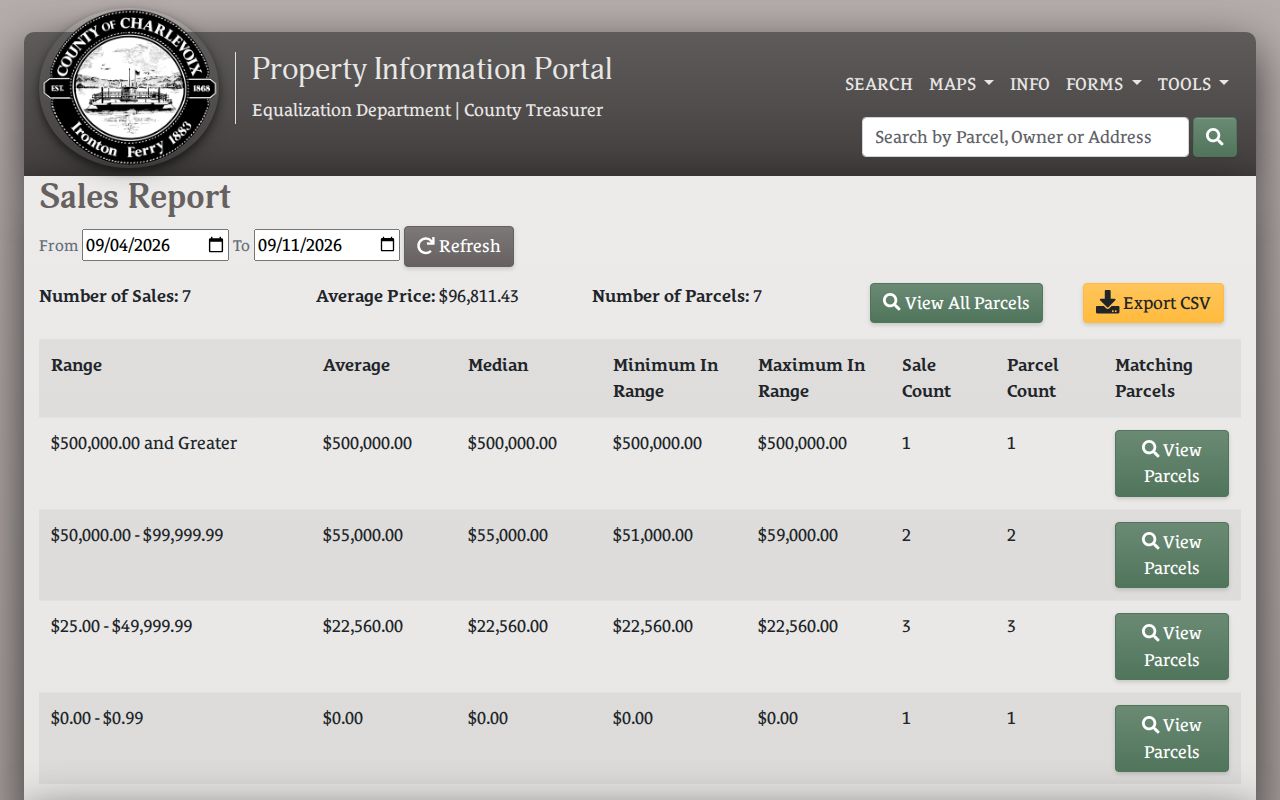
Carry a parcel, party, and date from the report into the recorder search. Then inspect the deed and its stated consideration.
Maps Span Mainland and Island Parcels
Charlevoix County's historic 2010 aerial map covered roughly 400 square miles. About 57 of those square miles sit on Beaver Island. About 343 sit on the mainland. Current users can enter the PivotPoint map or use Michigan's statewide tax-parcel hub. The Standard Map is marked under development. The Advanced Tax Parcel Map keeps broader search and export options.
Mapped parcel lines help connect a place with an APN. So do roads, water, aerial imagery, municipal borders, and parcel labels. They prove no boundary, access right, or easement. The current recorded survey, plat, deed description, or court order carries greater weight.
Note: Equalization assigns parcel IDs and 11-word... Note: Equalization assigns parcel IDs and 911 addresses across 15 townships, while city planning and assessment records form separate municipal layers. City planning and assessment records form separate municipal layers.
Historic Charlevoix Land Records Survive
Charlevoix County began as Keskauko County in 1840. It took its present name in 1869. The Archives of Michigan county guide catalogs Charlevoix deeds recorded from 1852 through 1901, plus a separate Manitou deed series spanning 1854 to 1895. Mortgages, tax-land records, probate files, court records, plats, and tax rolls appear there too. Archive depth does not guarantee the same reach online. The modern recorder index may not reach that far.
Island parcels and older chains can span two counties. Researchers often need both the Charlevoix and Manitou series to complete a chain of title. Try old owner spellings, township-range-section descriptions, former county names, and plat names, and write to archive staff one or two weeks ahead of a visit with the legal description and series identified.
Library Sources Rebuild House History
The Charlevoix Public Library Michigan Room goes deeper. Newspapers run from 1869 through 2016. Add obituaries from 1900 forward, yearbooks, oral histories, photographs, Earl Young material, and a digitized 1901 county plat book. The plat book is a standout. Together these sources supply leads for name variants, old subdivision names, building history, and estate notices, and the library's local-history screen gathers every collection in one place.
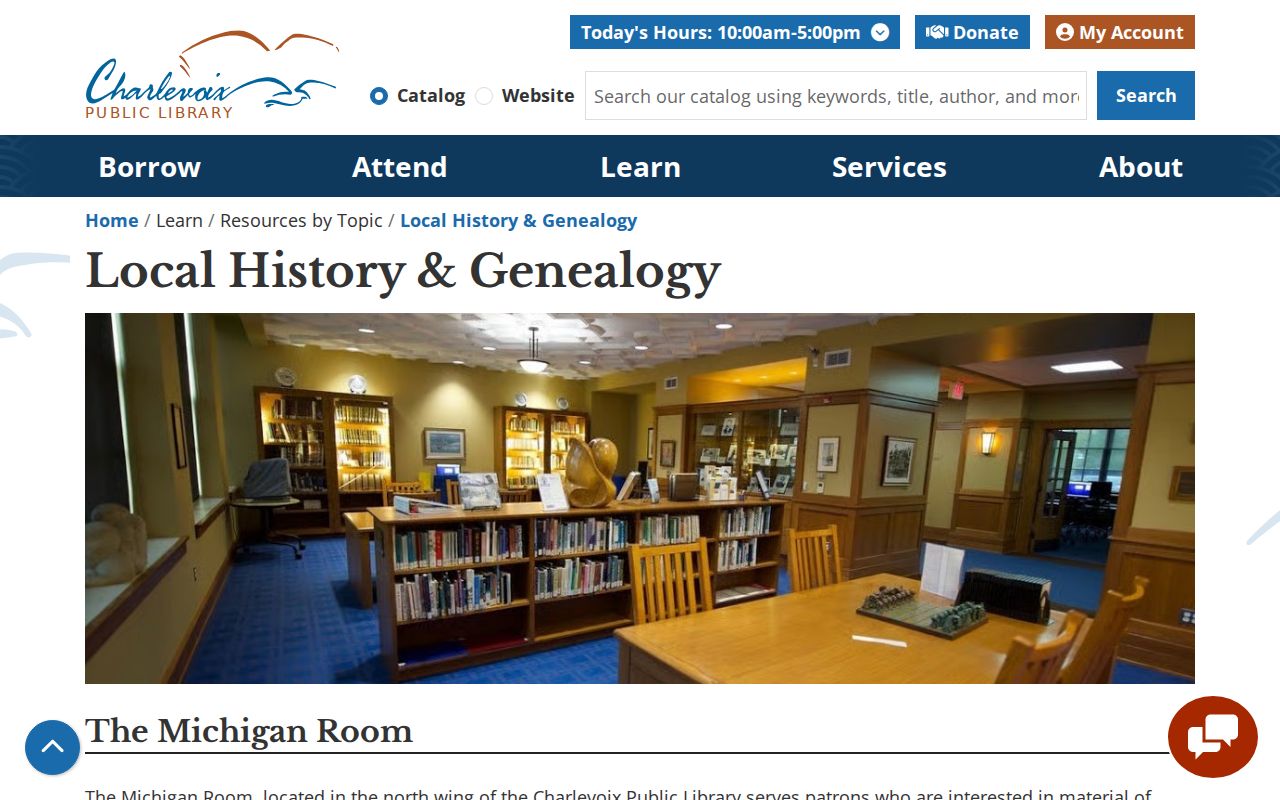
Confirm each newspaper or plat clue first. Match it to the current parcel number and a recorded instrument before drawing any title conclusion.
The County Portal Is Still Evolving
The county property portal is new. Its roots are recent. A January 14, 2026 County Board packet records an agreement accepted in October 2025, naming Pivot Point Partners to build the property-information and parcel-map website combining GIS, real-estate data, sales history, and property taxes. Township data-sharing resolutions matter here. They help explain why some panels depend on local participation, and the portal overview confirms Quick Search and local-unit data as parts of the current system.
Treat a missing field as a prompt, not a verdict. Contact the local assessor or Treasurer rather than assuming no record exists.
FOIA Reaches Offline Property Files
Michigan's Freedom of Information Act, MCL 15.231 et seq., opens doors to offline files. Send a written request to the public body's FOIA coordinator naming the record series, parcel or address, office, and date range. Ask for electronic delivery where practical. The public body generally answers within five business days. Extensions of ten more business days are allowed. Fees under MCL 15.234 can cover search, examination, review, separation, copying, and mailing. FOIA cannot unlock sealed files or override court-record rules. FOIA shines on older material. Think assessment rolls, permit logs, zoning records, Board of Review minutes, map data, and retention details.
Charlevoix Court Records Explain Disputes
A deed or assessment card rarely explains a dispute. Foreclosures, quiet-title suits, partitions, boundary fights, construction claims, lien enforcement, and probate transfers all live in court files. The Michigan MiCOURT search leads the way. It covers public Circuit, District, and Probate dockets statewide. Charlevoix County's 33rd Circuit, 90th District, and 7th Probate District offices sit at 301 State Street. The local clerk, not the online docket, holds the official case file. The clerk also provides any certified copies.
For a property dispute, capture the case number, court division, parties, filing date, complaint or petition, judgment, exhibits, survey, and final disposition. Then return to the recorder. There you can locate any lis pendens, judgment, release, easement, sheriff's deed, or other instrument. It implements the court's action. MiCOURT excludes protected categories. A missing online filing may require contact with the clerk. Michigan court-record rules govern judicial files. FOIA is no substitute for the court's access process.
Charlevoix Cities Add Permit Records
Three cities add a municipal layer. Boyne City, Charlevoix, and East Jordan each extend county property records with local material. Boyne City and East Jordan lean on BS&A-connected property and permit interfaces. The City of Charlevoix publishes its own assessor, zoning, planning, and historic-district material. A city approval can document proposed work. It may also cover a site plan, zoning conditions, inspections, or a boundary request. It cannot transfer title.
Route each question by jurisdiction. County deeds stay with the Register of Deeds. Parcel identity stays tied to the county APN. Building Safety, a city planning office, or meeting archives may hold project records. At city edges, verify the tax district and municipal boundary. Do not rely on the postal city. East Jordan's land-division requirements run deep. Expect survey, easement, legal-description, tax, notarization, and adjacent-owner information. That file can explain a changed parcel shape. The recorded combination instrument and current GIS complete the trail.
Charlevoix Tax Records Split by Unit
Michigan uses several assessment figures, and mixing them causes trouble. Equalization aims for uniform assessment at 50 percent of true cash value. State Equalized Value, or SEV, captures that equalized number. Taxable Value is different. Proposal A shapes it. It can stay below SEV until a transfer generally uncaps it the next year. A Principal Residence Exemption removes up to 18 mills of local school operating tax. It should not be confused with the homestead income-tax credit.
PivotPoint may display assessment details, optional billing, and delinquent-tax data where the local unit takes part. An empty tax panel proves nothing about exemptions or a zero balance. For a unit's roll, call that city or township assessor. For county tax-receivable, delinquency, or tax-search matters, contact the Charlevoix County Treasurer. Form 2368 is the state PRE claim form. It is generally due by June 1 for the summer levy. Assessment and PRE appeals follow their own notice dates and procedures.
Note: Match every value to its field label, assessment year, tax unit, and source before comparing Charlevoix County parcels.
Charlevoix Court Records Explain Disputes
Some property records only make sense after you read the court file behind them. Probate files can matter too. Foreclosure, quiet title, partition, boundary and easement litigation, lien enforcement, and probate transfers can all generate a docket trail. That trail often forms before any new instrument reaches the recorder. The Michigan MiCOURT search offers an informational lead on public cases. It is not a certified court record. Protected categories stay unavailable.
The 33rd Circuit, 90th District, and 7th Probate District offices all sit at 301 State Street in Charlevoix. Ask the right clerk for the official complaint, petition, order, judgment, exhibit, survey, or certified copy. Then turn to the Register of Deeds. Ask there for the lis pendens, release, easement, sheriff's deed, treasurer's deed, or other instrument that applies the outcome to the land.
Michigan FOIA does not govern judicial case files. Court access runs through Michigan Court Rule Chapter 8 plus any sealing or redaction order. A docket hit alone cannot establish lien priority or current ownership.
Limits of Charlevoix County Property Records
Charlevoix County property records can identify a parcel, the owner carried on an assessment roll, recorded transfers, stated sale data, assessment values, tax fields, legal descriptions, plats, and public permit or court events. Each source fills a defined role. An assessor record can lag a recent deed. A zero-dollar sales row may reflect an estate, trust, or nominal transfer. A map line is visual guidance, never a surveyed boundary. A recorder index is not a certified document.
The official sources keep their own limits. Michigan's Address Confidentiality Program can substitute a designated address for eligible survivors. Certain court and probate records are sealed or protected. Use owner data only for lawful purposes such as property research, boundary questions, purchase diligence, estate work, tax review, and civic transparency.
Lawful use. A Charlevoix County records search is not a title opinion, appraisal, or legal survey. Never use public owner information to stalk, harass, or harm anyone.