
Find Out Who Owns a Charlevoix County Property
Two county sources answer the question. The PivotPoint Property Information Portal supplies the assessment-roll lead, matching each parcel to its owner of record. The Register of Deeds supplies the deed that confirms the newest grantee.
- Search the property address and copy the exact parcel number.
- Read the owner name on the assessor roll, keeping the situs and mailing address separate.
- Search the latest matching grantee in the county recorder index and compare the legal description.
- If the grantee is an LLC, use Michigan's entity registry to understand the named organization.
Sources That Identify a Charlevoix County Property Owner
No single screen answers ownership questions. Equalization maintains ownership records and parcel IDs, the recorder indexes deed records, and GIS adds the map context, each on its own schedule and for its own purpose.
| Source | Owner Info It Gives | Access |
|---|---|---|
| Assessment roll | Owner Name, mailing context, parcel and value lead | PivotPoint portal or Equalization |
| Recorder deed index | Latest grantee, grantor, date, document number, book/page | Registered online search or office counter |
| Michigan entity registry | Filings and identity details for an LLC or corporation | MiBusiness Registry Portal |
| GIS parcel viewer | Map location and nearby parcel context | PivotPoint map |
The owner of record is not always the occupant. A parcel can sit vacant. It may be leased, held by an LLC, or mailed to another city, so use Charlevoix County property records for legal names rather than occupancy.
The Starts-With Rule in a Charlevoix County Owner Search
PivotPoint Quick Search matches only what your text starts with. Parcel numbers, owner names, and street addresses must begin with the characters you type. Search a middle word and the record seems missing. Advanced Search fixes this. It splits Owner Name, Parcel Number, House Number, Direction, Street Name, and Street Type into separate fields. Individuals work best in last-name-first form. Copy exact names from a deed or tax notice. Try alternate initials for people. Remember that sales samples show estates, trusts, LLCs, and out-of-county mailing addresses. So a narrow everyday-name search will not carry the day.
Trace the Charlevoix County Owner to the Newest Deed
The Charlevoix County Register of Deeds index closes the loop. It documents Grantor, Grantee, Both Names, date range, document type, and document number routes. Basic search wants last name first, no punctuation. Advanced adds a wildcard plus include and exclude operators. Match the deed's legal description or parcel reference. Online searching needs brief registration, and PDF images cost extra. For a certified copy or an unresolved result, call 231-547-7204 or visit 13513 Division Street after confirming current hours.
Note: The county has not published a verified online-index cutoff year, so older ownership may require office or archive research.
Identify an LLC Behind a Charlevoix County Parcel
A recorded grantee that is a company stays the owner of record. Use the Michigan MiBusiness Registry next. It holds organization filings, annual reports or statements, certificates, and historical cards, and it launched in June 2025. Entity context does not transfer title, though. Nor does a listed agent own the land.
Trust and estate names need different care. Search both recorder party roles and name variants before turning to probate. MiCOURT offers a docket lead, but the local probate file and the recorded deed are the stronger evidence.
Separate Mailing Address From Charlevoix County Situs
Situs is where the parcel physically sits. The mailing address is where assessment notices go. PivotPoint sales examples pair Charlevoix County property with a Petoskey post-office box, so correspondence geography never pins down the parcel's municipality.
- Owner of record
- The name carried on the assessment roll at its present processing stage.
- Grantee
- The party receiving an interest in a recorded instrument.
- Title
- The legal ownership interest, which an index result alone does not establish.
- Situs
- The parcel's physical address, distinct from the owner's mailing address.
A $0 Charlevoix County Sale Does Not Erase an Owner
The county's weekly sales table shows zero-dollar rows. Those transfers run among estates, trusts, LLCs, and people. A $0 amount can flag a nominal or internal move. It does not mean the parcel had no value or that ownership stood still. Treat the sales report as a discovery index. Then open the recorded instrument and check its parties, deed type, date, and legal description. The page on the current Charlevoix County owner digs further. It matches the newest deed with the roll.
See the Charlevoix County Owner Search Modes
The PivotPoint Basic and Advanced Search page keeps its modes separate. Owner, parcel, and address each get a clear field. That makes it the practical screen for turning a known address into the assessment-roll name used in the rest of the owner search.
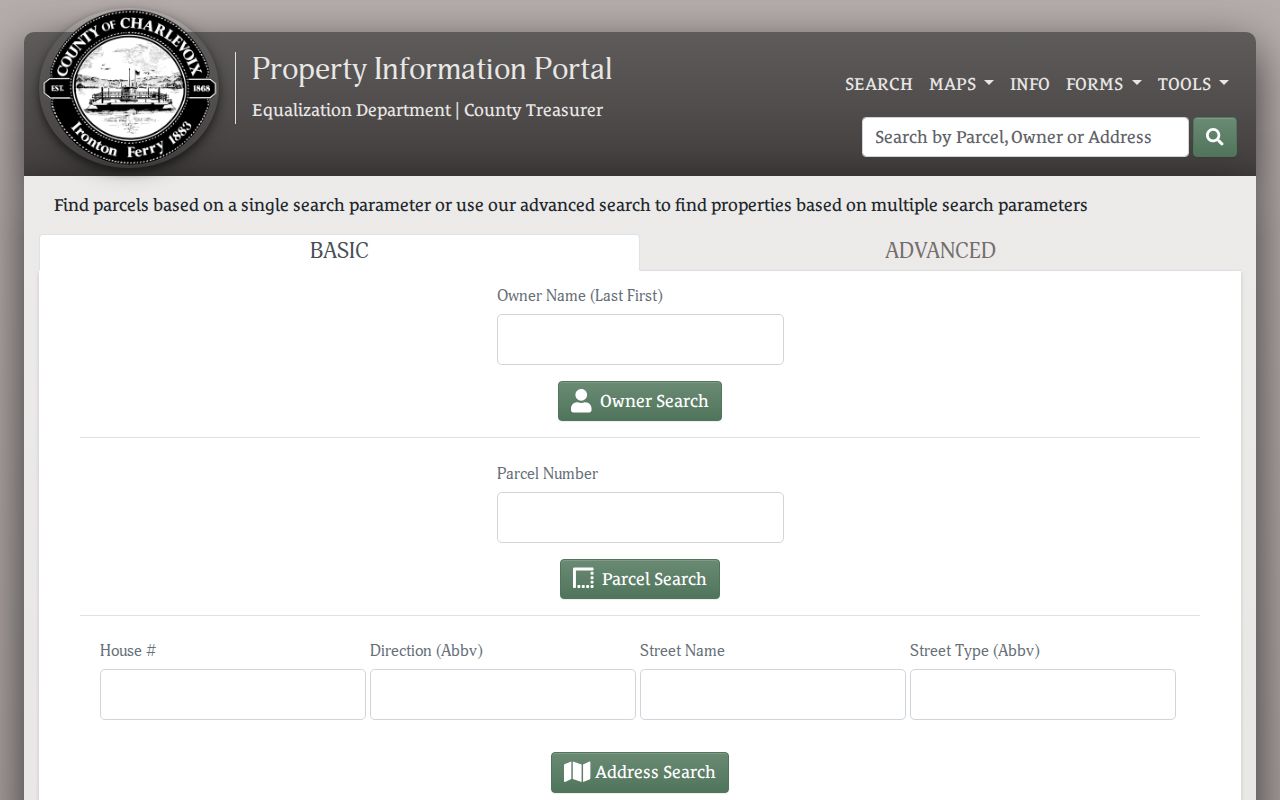
Copy the result exactly. Do not paraphrase it. A last-name-first entry, a trustee phrase, an estate label, or an LLC suffix gives the precise spelling the recorder search needs. If the screen shows no processing date, do not assume the owner reflects a deed recorded yesterday.
When a Charlevoix County Property Owner Is an Estate
An estate name signals moving parts. The roll, probate, and deed rarely align. Search the recorder for a personal-representative or fiduciary deed. Use the 7th Probate District file when authority actually matters to the transfer. MiCOURT gives a public docket lead, but wills and several protected probate categories stay off display.
The probate office sits at 301 State Street. Call 231-547-7214 or 231-547-7215. For older matters, the Archives guide covers probate calendars from 1882 through 1968 and case files from 1882 through 1970. An obituary helps with name variants, but it does not convey the parcel.
Ask Charlevoix County Offices When the Owner Search Fails
Equalization sorts out parcel IDs, ownership records, legal descriptions, and 911 addresses. Call 231-547-7230 or write to equalization@charlevoixcounty.org. The Register of Deeds handles indexed instruments and certified copies at 231-547-7204. Confirm the recorder's current location before any visit, since official directories disagree. When a roll, historical list, or administrative file never reaches the internet, a focused written request under the Michigan Freedom of Information Act is the right tool. Name the parcel, the record series, and the date range. The public body usually answers within five business days. It may claim a written extension of up to ten more. Judicial case files answer to court-access rules instead.
Build a Two-Source Charlevoix County Owner Answer
Build the answer as a dated comparison. The assessment roll showed one owner name when checked. The newest matching recorded deed named a grantee on its recording date. Add the parcel number and enough legal description to prove both records describe the same land. When sources disagree, report the difference and ask about processing rather than picking a favorite name.
The discipline also guards against same-name errors. One search can return several people, trusts, or entities. The parcel number and legal description narrow the match to a single property. A title professional still matters when competing interests, liens, probate authority, or an unrecorded claim could shift the legal conclusion.
Leave the transfer amount out of the ownership answer. PivotPoint's weekly sales evidence lists zero-dollar rows alongside estate, trust, and entity parties. A zero amount can still mark a real recorded transfer. The grantee and legal description, not the displayed amount, tell you which deed to review. Separate the execution date from the recording date, too. The public index is organized around the recorded event.
Limits When Asking Who Owns This Charlevoix County Property
An owner name on a public roll proves none of the harder questions. It does not establish title, occupancy, beneficial interests behind a trust, or an unrecorded claim. Michigan's Address Confidentiality Program can give qualifying survivors a substitute designated address with mail forwarding. So a protected mailing address is never a clue to physical location.
Where reliance matters, weigh the latest recorded deed. Also weigh the legal description, releases, probate or court instruments, and a professional title examination together. Report suspected forged or fraudulent instruments to the Register of Deeds. Notify the proper legal authorities as well. The county offers no property-fraud-alert signup.
Lawful use. Use Charlevoix County owner records for legitimate property research. Never use an address or owner name to stalk, harass, threaten, or harm anyone.